

Healthcare diagnostics company Quest Diagnostics (NYSE:DGX) reported revenue ahead of Wall Street’s expectations in Q3 2026, with sales up 10% year on year to $3.1 billion. The company’s full-year revenue guidance of $12.09 billion at the midpoint came in 0.6% above analysts’ estimates. Its non-GAAP profit of $3 per share was 4.4% above analysts’ consensus estimates.
Is now the time to buy Quest? Find out by accessing our full research report, it’s free.
Quest (DGX) Q3 2026 highlights:
- Revenue: $3.1 billion vs analyst estimates of $3.07 billion (10% year-on-year growth, 1% beat)
- Adjusted EPS: $3 vs analyst estimates of $2.87 (4.4% beat)
- Management raised its full-year Adjusted EPS guidance to $11.30 at the midpoint, a 1.3% increase
- Operating Margin: 15.5%, up from 13.7% in the same quarter last year
- Free Cash Flow Margin: 14.4%, similar to the same quarter last year
- Sales Volumes rose 14.5% year on year (12.5% in the same quarter last year)
- Market Capitalization: $26.37 billion
"We delivered revenue growth of 10% and adjusted EPS growth of over 15% on continued strength across our physician, hospital and consumer channels, complemented by productivity gains from automation and AI," said Jim Davis, Chairman, CEO and President. "Our robust organic revenue growth demonstrates that our solutions are fulfilling the expanding clinical care needs of an aging population as well as the increasing number of people focused on prevention and wellness. With these growth trends and our strong performance, we are raising our revenue and EPS guidance for the full year."
Company overview
Processing approximately one-third of the adult U.S. population's lab tests annually, Quest Diagnostics (NYSE:DGX) provides laboratory testing and diagnostic information services to patients, physicians, hospitals, and other healthcare providers across the United States.
Revenue growth
A company’s long-term performance is an indicator of its overall quality. Any business can have short-term success, but a top-tier one grows for years. Unfortunately, Quest’s 1.4% annualized revenue growth over the last five years was tepid. This fell short of our benchmarks and is a poor baseline for our analysis.
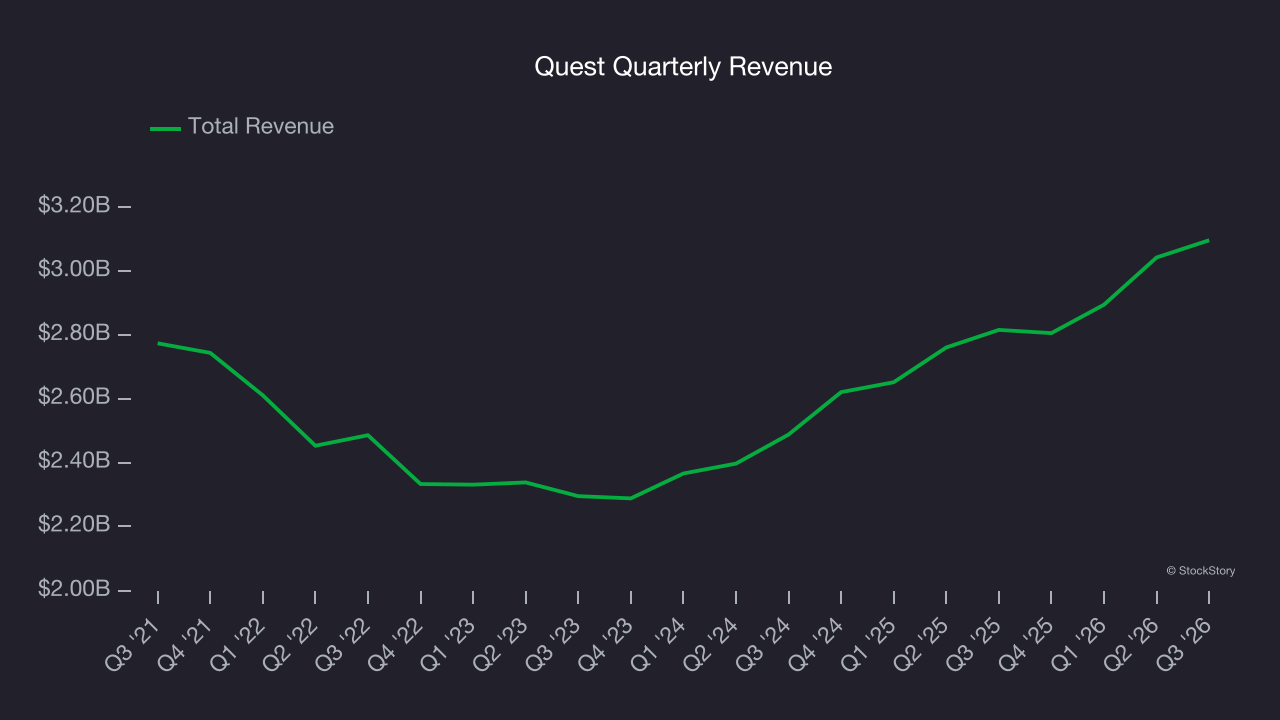
We at StockStory place the most emphasis on long-term growth, but within healthcare, a half-decade historical view may miss recent innovations or disruptive industry trends. Quest’s annualized revenue growth of 11.4% over the last two years is above its five-year trend, suggesting some bright spots. 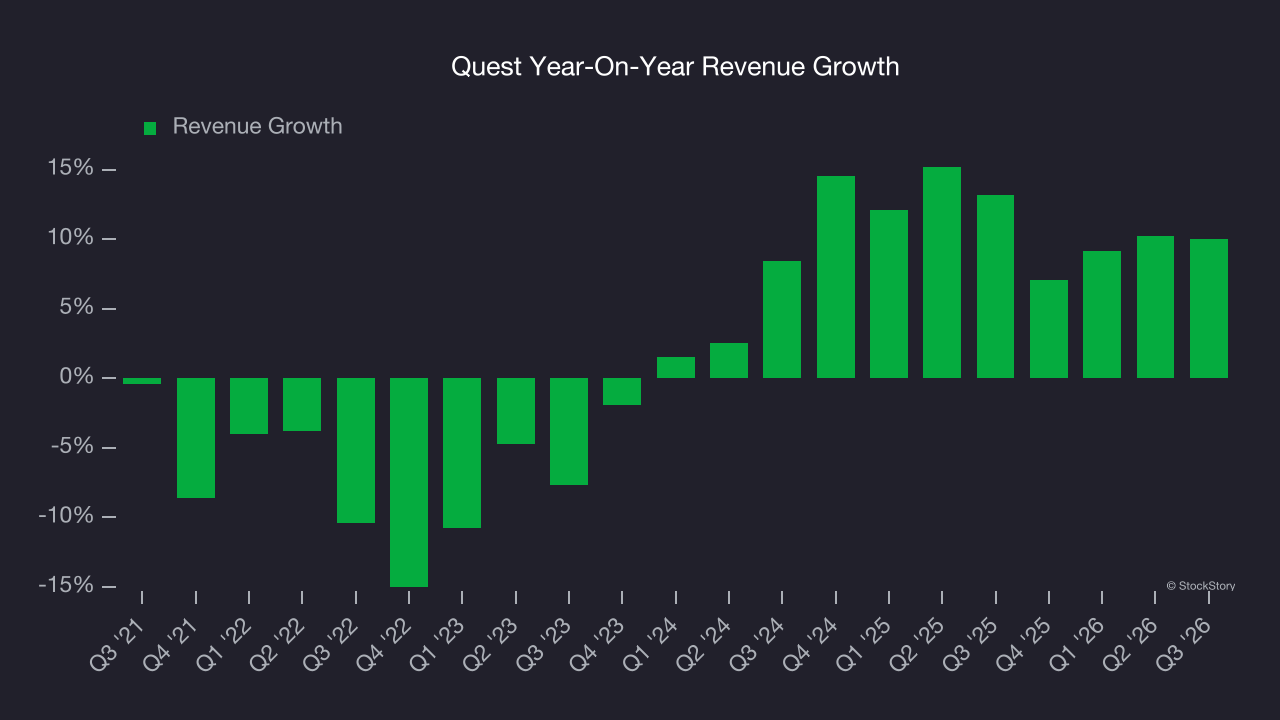
We can dig further into the company’s revenue dynamics by analyzing its number of requisition volumes. Over the last two years, Quest’s requisition volumes averaged 12.8% year-on-year growth. Because this number is in line with its revenue growth, we can see the company kept its prices fairly consistent. 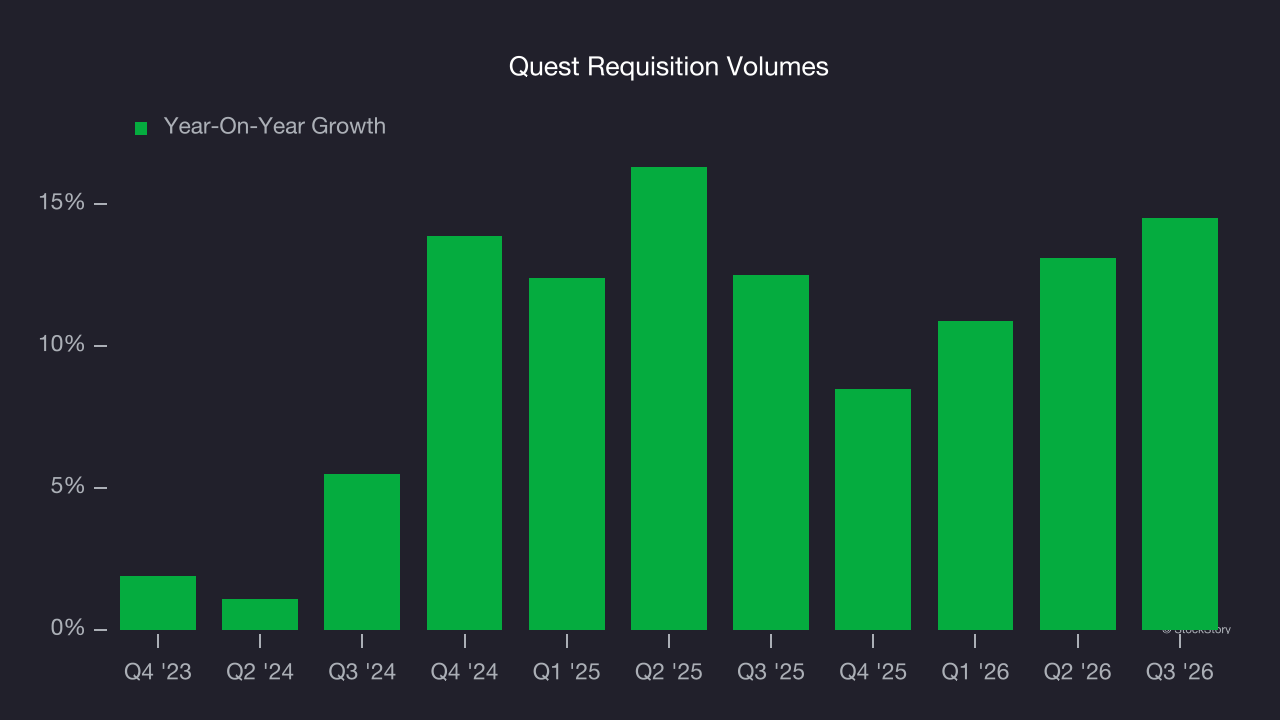
This quarter, Quest reported year-on-year revenue growth of 10%, and its $3.1 billion of revenue exceeded Wall Street’s estimates by 1%.
Looking ahead, sell-side analysts expect revenue to grow 4.8% over the next 12 months, a deceleration versus the last two years. This projection doesn’t excite us and indicates its products and services will see some demand headwinds.
ALSO WORTH WATCHING: Nvidia’s Quiet Partner. Nvidia’s chips cost a hundred grand. The connectors that make them work cost even more. One company makes them all.
Every AI server needs specialized infrastructure the chip companies don’t make. High-speed cables. Power connectors. Thermal sensors. This 90-year-old company built a monopoly on it. The AI boom just started. This stock is still flying under the radar. Claim The Stock Ticker Here for FREE.
Adjusted operating margin
Quest has managed its cost base well over the last five years. It demonstrated solid profitability for a healthcare business, producing an average adjusted operating margin of 16.5%.
Looking at the trend in its profitability, Quest’s adjusted operating margin decreased by 3.5 percentage points over the last five years. This raises questions about the company’s expense base because its revenue growth should have given it leverage on its fixed costs, resulting in better economies of scale and profitability.
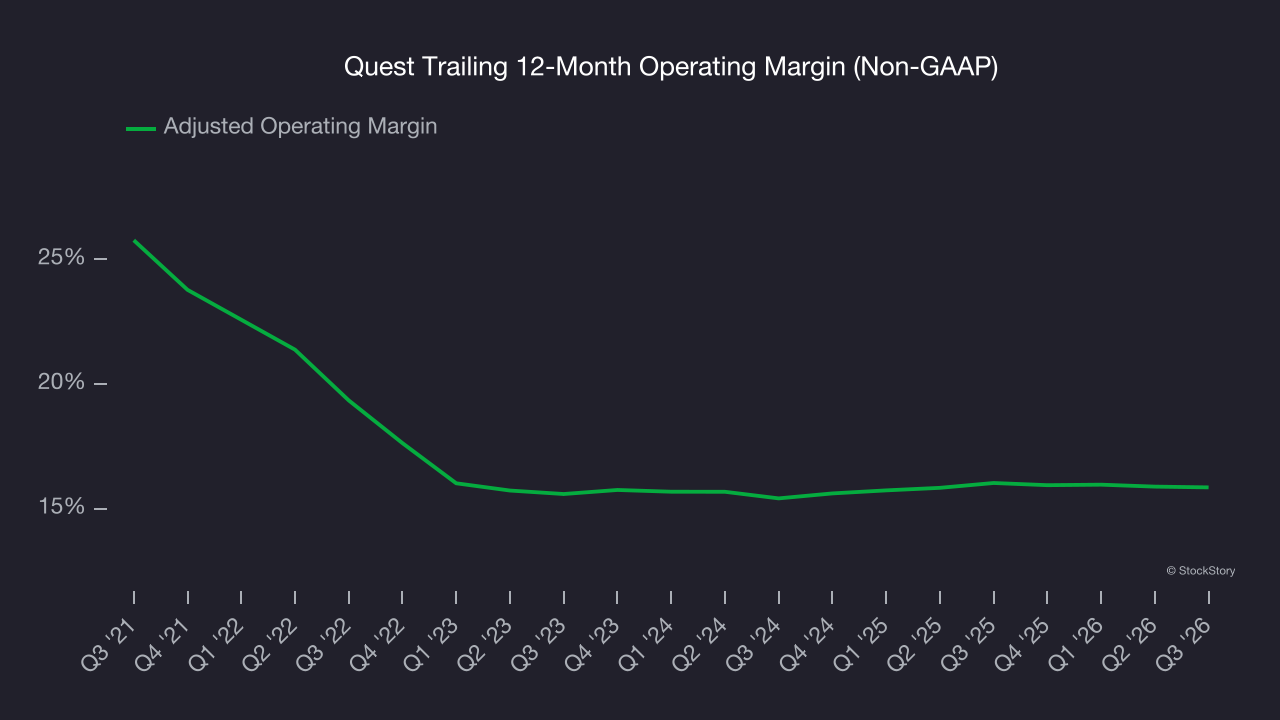
In Q3, Quest generated an adjusted operating margin profit margin of 16.1%, in line with the same quarter last year. This indicates the company’s overall cost structure has been relatively stable.
Earnings per share
Revenue trends explain a company’s historical growth, but the long-term change in earnings per share (EPS) points to the profitability of that growth — for example, a company could inflate its sales through excessive spending on advertising and promotions.
Sadly for Quest, its EPS declined by 6.4% annually over the last five years while its revenue grew by 1.4%. This tells us the company became less profitable on a per-share basis as it expanded due to non-fundamental factors such as interest expenses and taxes.
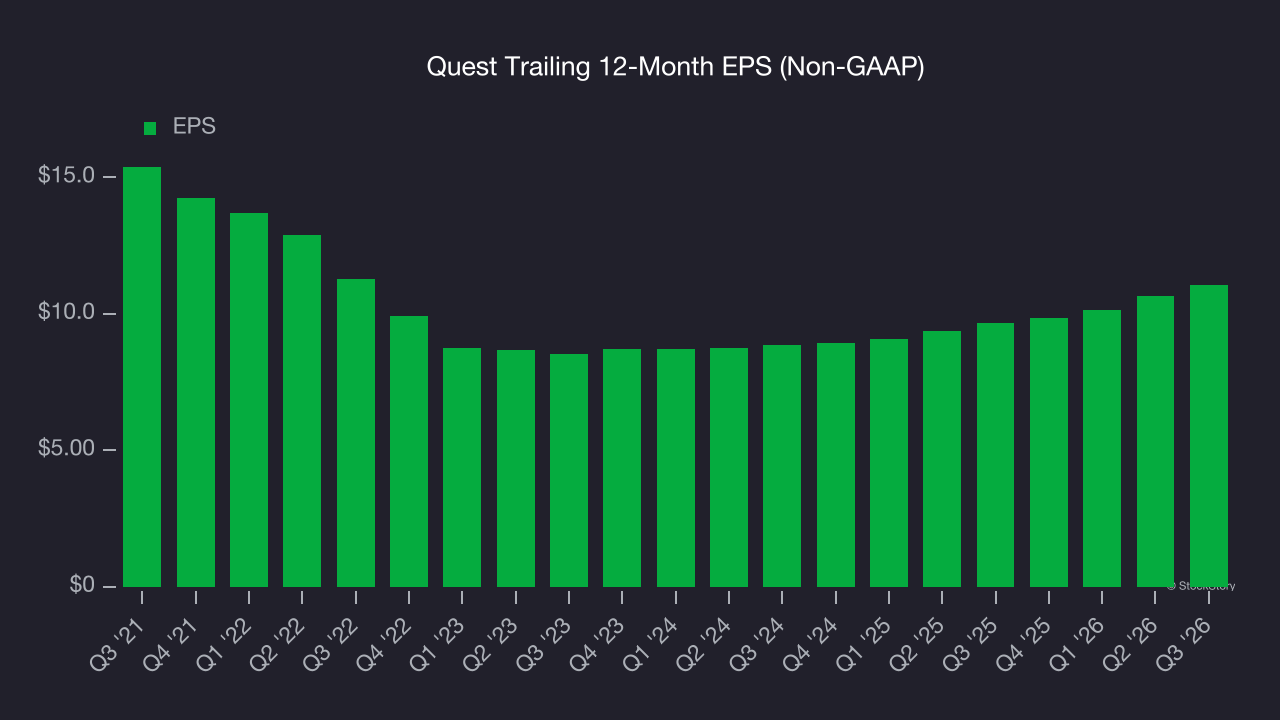
We can take a deeper look into Quest’s earnings to better understand the drivers of its performance. As we mentioned earlier, Quest’s adjusted operating margin was flat this quarter but declined by 3.5 percentage points over the last five years. This was the most relevant factor (aside from the revenue impact) behind its lower earnings; interest expenses and taxes can also affect EPS but don’t tell us as much about a company’s fundamentals.
In Q3, Quest reported adjusted EPS of $3, up from $2.60 in the same quarter last year. This print beat analysts’ estimates by 4.4%. Over the next 12 months, Wall Street expects Quest’s full-year EPS to grow 6.1% from $11.04 to $11.72.
Key takeaways from Quest’s Q3 results
It was good to see Quest narrowly top analysts’ revenue expectations this quarter. We were also glad its full-year revenue guidance slightly exceeded Wall Street’s estimates. Overall, this print had some key positives. Investors were likely hoping for more, and shares traded down 1.8% to $234.67 immediately following the results.
So should you invest in Quest right now? What happened in the latest quarter matters, but not as much as longer-term business quality and valuation, when deciding whether to invest in this stock. We cover that in our actionable full research report which you can read here (it’s free).