
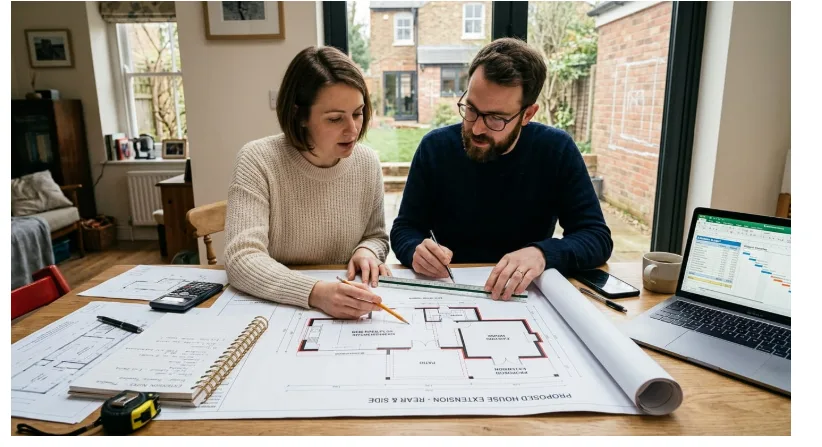
Planning a house extension is one of the best decisions you can make as a UK homeowner, but it’s also one of the easiest to get wrong. Most people don’t fail because of bad builders or bad luck. They fail because they started without a plan.
How to start planning an extension in 2026:
- Define Your Brief: Prioritise “success” over just “more space.”
- Check Planning Status: Verify Permitted Development (PD) rights.
- Set a 2026 Budget: Benchmark at £1,800–£3,000/m².
- Choose Extension Type: Rear, Side, Double, or Loft.
- Appoint a Design Team: Architect vs. Design-and-Build.
- Understand Building Regs: Mandatory Part L thermal compliance.
- Vet Your Builder: Local portfolio and contract verification.
- Manage the Build: Inspections and Completion Certificate.
Let us explain the above steps in detail.
Step 1: Define Your Brief Before You Do Anything Else
The single most valuable hour you’ll spend on this project is before you call anyone.
Write down, clearly:
- What problem are you solving? A cramped kitchen? No home office? A growing family with nowhere to put guests?
- What does success look like? Be specific. “Enough room to host Sunday lunch for 10 without the kitchen feeling chaotic” is useful. “More space” is not.
- Will you stay in during the build? This affects sequencing, contractor choice, and your budget for temporary disruption.
- What’s your hard deadline, if any? A baby due in six months changes everything.
A clear brief protects you at every stage. When a designer presents a layout, you can evaluate it. When a builder quotes, you can compare fairly. When changes are proposed on-site, you have a reference point.
Buon Construction Tip: Don’t skip this step. It takes two hours and saves months of confusion.
Step 2: Check Your Planning Permission Status First
Before spending a penny on design, confirm whether your extension needs formal planning permission because many don’t.
Permitted Development Rights (PDR) allow most standard UK houses to be built without a full planning application, provided you stay within these limits:
- Single-storey rear extensions: up to 4m deep on a detached house, 3m on a semi or terrace
- The extension must not exceed half the total area of land around the original house
- Must not be higher than the existing roofline
- Materials must match the existing property
Since 2019, the Neighbour Consultation Scheme has extended this to 8m (detached) or 6m (semi/terrace) for single-storey rear extensions with prior notification to your council.
You will need full planning permission if:
- Your home is a listed building (you’ll also need Listed Building Consent)
- You’re in a conservation area, National Park, or AONB
- Your PDR was removed by a previous planning condition
- You’re building a two-storey extension that exceeds PDR limits
Always apply for a Lawful Development Certificate (LDC) even when you believe PDR applies. It costs £250–£450 in 2026, provides legal certainty, and is essential for a smooth property sale in the future.
Don’t rely on what your neighbour or builder tells you. Verify with your Local Planning Authority.
Step 3: Set a Realistic Budget Including Everything
Most homeowners underestimate extension costs because they only count the build. Here’s the full picture.
Typical build-only costs (UK, 2026):
| Extension Type | Cost per m² (2026) | Example (20m²) |
| Single-storey, standard spec | £1,800 – £2,500 | £36,000 – £50,000 |
| Single-storey, high spec | £2,800 – £4,000+ | £56,000 – £80,000+ |
| Double-storey, standard spec | £1,600 – £2,200 | £64,000 – £88,000 (40m²) |
| Loft conversion | £40,000 – £65,000 (fixed) |
Additional costs you must include:
- Architect or design fees: 5–10% of build cost (often included in design-and-build contracts)
- Structural engineering: £500 – £1,500
- Planning application fee: £322 (Householder application, England 2026)
- Lawful Development Certificate: £250 – £450
- Building Regulations fees: £500 – £1,200
- Party Wall Surveyor (if applicable): £700 – £2,000+
- Contingency: minimum 10–15% non-negotiable
The double-storey value argument: A two-storey extension costs less per m² than a single-storey extension because foundations, scaffolding, and the roof are shared. If you’re anywhere near considering it, price both before you decide.
Step 4: Choose the Right Type of Extension
Not every option suits every home. Here’s a quick decision guide.
Rear extension: Most common. Projects into the back garden. Best for open-plan kitchen-diner living. Particularly effective in Nottinghamshire and the East Midlands, where rear gardens tend to be generous.
Side return extension transforms Victorian and Edwardian terraces by filling the underused alley beside the kitchen. Dramatic improvement in light and width for relatively modest cost.
Double-storey extension: Best cost-per-square-metre. Adds a bedroom and bathroom above while creating a large reception space below. Planning rules require the extension to sit at least 7m from the rear boundary.
A loft conversion adds space without touching the garden. A dormer loft with a master bedroom and en-suite is consistently the highest-value addition for resale.
Wrap-around extension: Combines rear and side return into an L-shape. Transformative. Typically requires full planning permission.
Step 5: Appoint a Designer, Architect or Design-and-Build?
Once your brief and budget are set, you need professional design input. There are two main routes.
Standalone architect (RIBA-accredited) Best for complex or high-value projects. The architect works solely for you, produces drawings that any builder can price against, and can manage the build independently. Gives you the most control.
Design-and-build contractor: One team handles design, planning, and construction under a single contract. Streamlines communication, reduces programme time, and gives you a single point of accountability. For most standard to mid-complexity extensions, it’s the smarter route and experienced local firms like Buon Construction manage every stage so nothing falls through the gaps.
This route often eliminates the ‘budget gap’ where an architect designs something a builder can’t actually afford to build.
Before appointing anyone, ask:
- Can I see completed projects similar to mine?
- Can you provide references from clients 6+ months post-completion?
- What’s your planning application success rate?
- Will the same person manage my project throughout?
Step 6: Understand Building Regulations (Separate from Planning)
This is where many homeowners get confused. Planning permission and Building Regulations are entirely separate, and both are mandatory where they apply.
Planning permission = whether you can build it. Building Regulations = how it must be built.
Building Regulations for extensions cover:
- Structure foundations, steelwork, and walls, signed off by a structural engineer
- Fire safety escape routes, fire doors, and smoke detection
- Thermal performance Part L compliance for walls, roof, and floors
- Drainage connection to existing systems and surface water
- Electrics and plumbing notifiable works under Part P
- Ventilation especially important in open-plan layouts
- Under the 2026 Building Regulations (Part L), extensions now require superior U-values for walls (0.18) and windows (1.2).
Your builder or architect manages the process with either your Local Authority Building Control (LABC) or an Approved Inspector. What you must do: ensure you receive a Completion Certificate at the end. Without it, selling your home becomes considerably more complicated.
Step 7: Find and Appoint the Right Builder
The best-designed extension in the world fails with the wrong builder. This step deserves the most care.
How to find a reliable extension builder:
- Personal recommendation: Ask neighbours who’ve had extensions. Look at the actual finished work. This still beats every other method.
- Local search: Searching for Home Extensions Nottingham specialists in areas like West Bridgford, Beeston, or Wollaton surfaces vetted local experts. National lead-gen platforms often lack the specific knowledge of Nottingham City Council or Rushcliffe planning nuances.
- In Nottingham, councils are increasingly strict on Sustainable Drainage Systems (SuDS) for rear extensions, ensuring your builder isn’t planning to just ‘pipe it into the old drain’ without checking.
- Trade body membership, Federation of Master Builders (FMB), NHBC, or LABC warranty schemes require vetting.
When reviewing quotes:
- Get a minimum of three, all based on the same drawings and spec
- Check what’s included vs. excluded vs. provisional
- Be wary of upfront deposits above 10–15%
- Confirm VAT is included, not added on top
- Ask for a realistic programme with named milestones
Red flags: Can start immediately (no reputable builder has a backlog). Requests cash. Provides a quote with no line detail. No public liability insurance. Walk away.
Always use a written contract; the JCT Minor Works or Homeowner Contract is the industry standard. Confirm public liability insurance of at least £2m.
Step 8: Manage the Build and Reach Completion
Once work starts, stay engaged. You don’t need to be on site daily, but you do need to be available and decisive.
Six things that matter most during the build:
- Set a communication rhythm. Arrange weekly or fortnightly site catch-ups. Regular updates prevent the “assumption errors” that lead to costly structural reworks.
- Make decisions fast. Aim for a 24-48 hour turnaround on choices like fittings and finishes. Client-side delay is the leading cause of project overruns in 2026.
- Verify mandatory inspections. Never let a builder cover foundations, steelwork, or drainage until Building Control has officially signed them off.
- Document every change. Confirm all verbal variations via WhatsApp or email. A dated paper trail is your only protection against end-of-project budget disputes.
- Snag before final payment. Identify minor defects before the team leaves. Retain 2.5–5% of the contract value until every snag is resolved.
- Secure your Completion Certificate. This digital “building passport” is legally required. Store it safely; you cannot sell, remortgage, or claim insurance without it.
Conclusion
The homeowners who have the smoothest extensions on time, on budget, no nasty surprises, all have one thing in common: they spent time at the beginning getting clear on their brief, their planning situation, and their realistic budget before anyone broke ground.
Start there. Everything else follows logically.
If you’re based in Nottingham or the wider East Midlands, working with a local team who knows your planning authority, your supply chains, and your building stock is a genuine advantage from day one.
Frequently Asked Questions
Do I need planning permission for a house extension?
Not always. Many extensions fall under Permitted Development Rights. But if you’re in a listed building or conservation area, you almost certainly do. Always verify with your Local Planning Authority before starting any work.
How much does a house extension cost in the UK?
A standard single-storey extension starts around £1,800–£2,500 per m² in the Midlands. We recommend budgeting a 15% contingency in 2026 to account for material price fluctuations during the build.
How long does the whole process take?
Typically, 6–12 months from initial planning to Completion Certificate. Planning permission (if required) takes 8 weeks. Design, engineering, and tendering add 2–3 months. The build itself is usually 8–20 weeks, depending on scale.
Do I need an architect?
Not legally. But for anything beyond a very simple extension, design input pays for itself, whether from a standalone architect or a design-and-build firm. It resolves problems on paper rather than on site, where they’re ten times more expensive.